

By Howard Teibel
Most organizational communication is treated as the exchange of information. But information does not create movement. Teams can spend hours in meetings sharing updates, opinions, and perspectives and still leave with little clarity, weak ownership, and no real change in behavior. The deeper issue is that communication is often not oriented to produce action.
At its best, communication helps people coordinate, make commitments, surface concerns, and move important work forward together. At its weakest, it creates avoidance, blame, passivity, and overload. Leaders often see the consequences - slow decisions, rework, low trust, weak accountability—but do not always recognize that the roots lie in everyday communication habits.
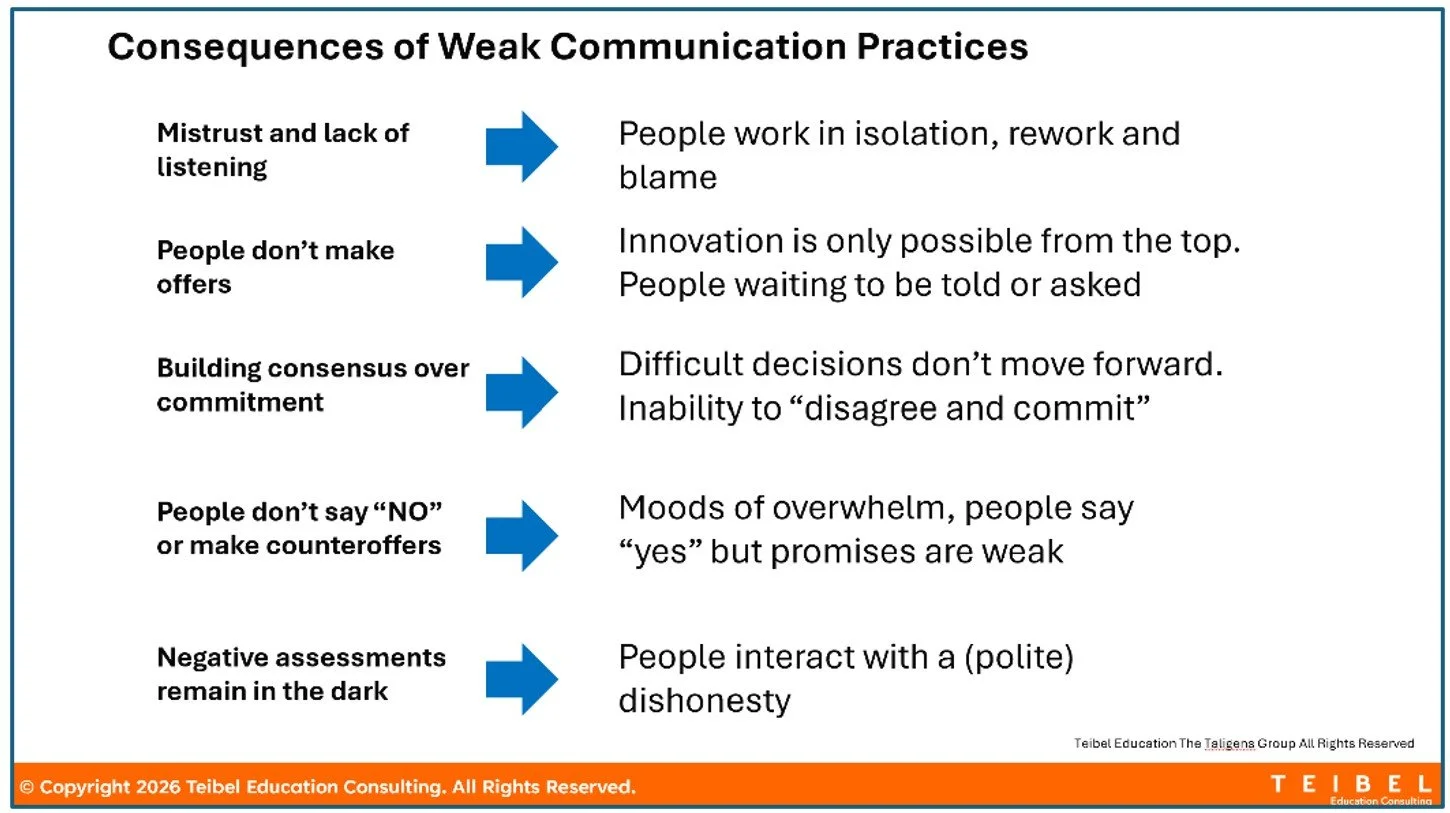
The principles below reflect five common weak communication practices and the organizational consequences they create. More importantly, they point toward a more effective way of working - one grounded in trust, clarity, and mutual responsibility.
1. Mistrust leads people to work around one another
When trust is weak, people rarely address it directly. Instead of naming concerns and working through them, they withdraw, avoid, or compensate. They begin to work in isolation, limit communication, and quietly route around the people they do not trust. Coordination breaks down. Rework increases. Blame becomes more common.
This is one of the most expensive communication failures in organizations because it often remains hidden. On the surface, people may look polite and professional. Underneath, they are withholding concerns, doubting one another’s reliability, and protecting themselves. The result is not only inefficiency, but also a culture in which people stop listening deeply and stop taking relational risks.
Stronger teams do not avoid mistrust. They create conditions where people can raise concerns about follow-through, competence, care, or sincerity in ways that are direct and workable. Trust is not built through good intentions alone. It is built through conversations that people are usually reluctant to have.
2. When people do not make offers, innovation stays at the top
Many organizations are filled with capable people who see unmet needs but wait to be told what to do. They carry out requests, manage assigned responsibilities, and work through their checklists, but they do not regularly make offers.
An offer is more than a suggestion or a vague willingness to help. While a request is proposing action to address one’s concern, an offer is proposing action to address another’s concern. When people know how to make offers, they begin to act with more ownership. They stop waiting for permission to notice what needs attention. They contribute beyond the narrow boundaries of their formal role.
Without this practice, innovation becomes centralized. New ideas, initiative, and problem-solving are expected to come from senior leadership, while everyone else waits for direction. That is a recipe for stagnation. The people closest to the work often see issues, opportunities, and emerging needs long before leaders at the top do. But unless an organization actively teaches people to make offers—and teaches managers how to receive them—much of that intelligence stays unused.
A stronger culture invites responsible initiative. It helps people ask: What concern do I see? What could I offer? What would it look like to step forward rather than wait?
3. Consensus is not the same as commitment
One of the most common ways organizations get stuck is by confusing consensus with commitment. Teams often believe they need broad agreement before they can move forward. As a result, important decisions stall, people keep revisiting the same issues, and momentum weakens.
But healthy teams do not require everyone to think alike. They require people to commit. Commitment means that even when individuals disagree with a decision, they choose to support it once it has been made. They may have voiced concerns, raised objections, or preferred another path, but they do not continue resisting from the sidelines after the decision is settled.
This is the discipline captured in the phrase “disagree and commit.” It is powerful because it allows organizations to honor differing viewpoints without becoming paralyzed by them. It separates participation from obstruction. It asks people to move beyond ego and certainty.
A commitment-based culture does not silence disagreement. It makes disagreement discussable and then asks for a decision and a promise of support. That shift alone can dramatically increase the pace and coherence of execution.
4. When negative assessments stay hidden, teams drift into polite dishonesty
Most people are uncomfortable giving direct feedback, especially when it may disappoint, frustrate, or provoke defensiveness in someone else. So instead of speaking to the person directly, they speak about them elsewhere. They vent privately, triangulate, or say nothing at all. Outwardly, the team remains courteous. In practice, honesty has eroded.
This creates what might be called polite dishonesty: a culture where people appear respectful, but important truths remain unspoken. Problems persist because the conversations needed to address them never happen. Frustration accumulates. Trust weakens further.
The challenge here is not just learning how to give a negative assessment. It is also learning how to receive one. Most people anticipate that direct feedback will be met with defensiveness: prove it, justify it and back off! If that is the expected response, people will continue to withhold what needs to be said.
Stronger teams practice a different response. Instead of reacting immediately, they learn to pause and ask, “Tell me more.” They distinguish between a reaction and a genuine inquiry and become more capable of hearing something difficult without collapsing into self-protection. The goal is not to eliminate discomfort but to build the capacity to work through difficult conversations in service of a stronger or better outcome.
5. When people cannot say no or make counteroffers, overwhelm becomes normal
In many workplaces, saying no feels risky or disloyal. People especially struggle with this in service-oriented roles, where responsiveness is part of their identity. So instead of declining or renegotiating requests, they say yes too quickly, absorb unrealistic timelines, and overcommit.
The result is predictable: stress rises, promises weaken, and overwhelm becomes part of the culture. People begin saying yes to things they cannot actually deliver on. They work late, resent the demand, and often fail to renegotiate in time. What looks like commitment on the surface is often a lack of boundaries and a lack of skill in negotiation.
This is where counteroffers become essential. A counteroffer is not refusal; it is a disciplined way of reshaping a request so that it becomes workable. It might adjust timing, scope, sequence, or deliverables. It allows someone to remain responsive without taking on commitments that are unrealistic.
Organizations become healthier when people know they are allowed to negotiate rather than simply absorb. Counteroffers reduce overload, strengthen promises, and create more realistic coordination across teams. They also help prevent one person’s urgency from automatically becoming everyone else’s crisis.
What these principles make possible
Taken together, these five principles reveal something important: weak communication is not a soft issue. It is a structural issue that shapes trust, decision-making and the ability to innovate in that community.
When leaders strengthen these practices, they create teams that listen more carefully, speak more directly and coordinate with greater clarity. People stop hiding concerns. They begin making stronger offers. They make room for disagreement without sacrificing movement. They develop the confidence to renegotiate rather than overpromise. Over time, that changes not just communication, but the underlying culture.
Culture shifts when people change how they speak, listen, commit, and respond to one another. That is the work. And when organizations invest in it, they create the kind of environment where people can do meaningful work with more trust, more ownership, and far less wasted energy.
Listen to our podcast: The Language of Action: Moving Beyond Communication Breakdown