
By Howard Teibel
Higher education is not suffering from a lack of talented people or good intentions. We suffer from deeply ingrained ways of being that leave consequential decisions unresolved, and leadership operating from individual priorities rather than shared commitments. We attribute these challenges to institutional complexity, dysfunctional shared governance practices or resistance to change. But what if the deeper problem lies in the ways we have learned to work together? What if the very practices we rely on to lead our institutions are the ones holding us back?
These five provocations offer a different way to think about trust, governance, leadership, and our capacity to act together.
Trust Is Not the Starting Point. It's the Outcome.
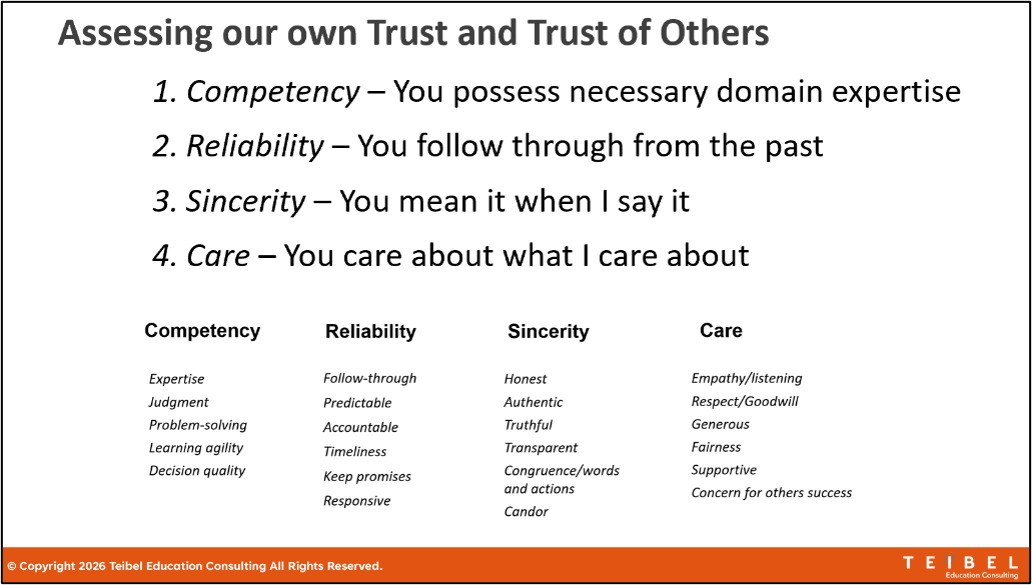
We spend enormous energy building trust through stronger relationships, greater transparency, and continual communication. While these matter, trust is ultimately grounded in our experience of one another. Do people do what they say they will do? Can we count on their competence, sincerity, and reliability? Are commitments renegotiated when circumstances change? Rather than treating trust as the foundation for working well together, can we recognize it as something to build through the everyday practice of making, honoring, and managing commitments?
Your Challenge: Where are you asking people to trust one another without changing the practices that created mistrust in the first place?
When Consensus Becomes the Enemy of Progress
Higher education values consultation, participation, and shared governance. In this historical tradition, we have confused consensus building with commitment. When consensus becomes a prerequisite for action, difficult decisions get postponed, accountability becomes unclear, and institutional momentum is nonexistent. The alternative is not authoritarian leadership. It is opening conversations around being clear about who has a voice, who has a vote and who has a veto. Building a practice where people can “disagree and commit” can transform high-quality decisions to high-velocity decision-making. Read this article on cultivating healthy shared governance.
Your Challenge: Where are you allowing the pursuit of consensus to delay consequential decisions, and what would become possible if you asked people to commit rather than agree?
The Conversations We Avoid Are Costing Us the Most.
All of us are aware of conversations that need to happen but we’re reluctant to initiate. Whether it’s about performance, resource allocation, leadership behavior, or competing priorities, avoiding these conversations rarely makes the underlying issues disappear. Instead, concerns harden into judgments, judgments shape how we interpret one another, and possibilities for action narrow.
What initially appears to be an effort to preserve relationships often produces the very mistrust and fragmentation we hope to avoid. Productive leadership requires the ability to distinguish facts from assessments, engage differences openly, and address breakdowns before they become institutional patterns. The real cost of avoidance is not simply the conversation we failed to have. It is the time, energy, trust, and possibility we lose while waiting.
Your Challenge: What conversation are you or your teams avoiding that, if initiated, could restore trust, open new possibilities, and move your institution forward?
Shared Governance Isn't Broken. Our Ability to Coordinate Action Is.
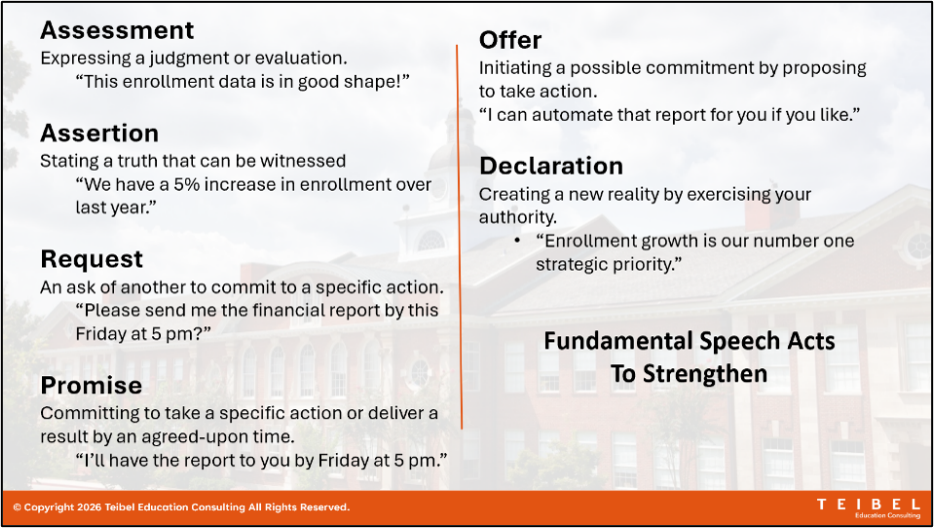
Many of the frustrations attributed to shared decision-making are failures of coordination. Faculty and administrators may have legitimate differences about institutional priorities, but these differences are far more difficult to navigate when expectations remain unspoken, responsibilities are confused with commitments, and promises are never explicitly established. More meetings and committees won’t produce better governance.
The opportunity is to build a culture of commitments. Effective governance requires more than clarity about responsibilities. It requires the discipline to make clear requests, negotiate meaningful promises, and renegotiate when circumstances change. What transforms governance is not simply our ability to deliberate together, but our capacity to coordinate action and deliver results.
Your Challenge: Where are you relying on assigned responsibilities rather than explicit commitments, and what conversations would strengthen your institution's capacity to act together?
Your Senior Leadership Team May Be the Biggest Barrier to Change.
Presidents and provosts often look outward to understand why institutional change is so difficult. Yet some of the greatest barriers may exist within our own leadership teams. When executives defend divisional interests, avoid difficult trade-offs, or fail to hold one another accountable, we reinforce the fragmentation we seek to overcome. A high functioning First Team puts the success of the institution above individual priorities and makes shared commitments the foundation for collective action. The most consequential change you can lead begins with your own leadership team.
Your Challenge: What would change if your senior leaders saw their primary responsibility as advancing the institution together, rather than protecting the interests of their own unites and those who report to them?