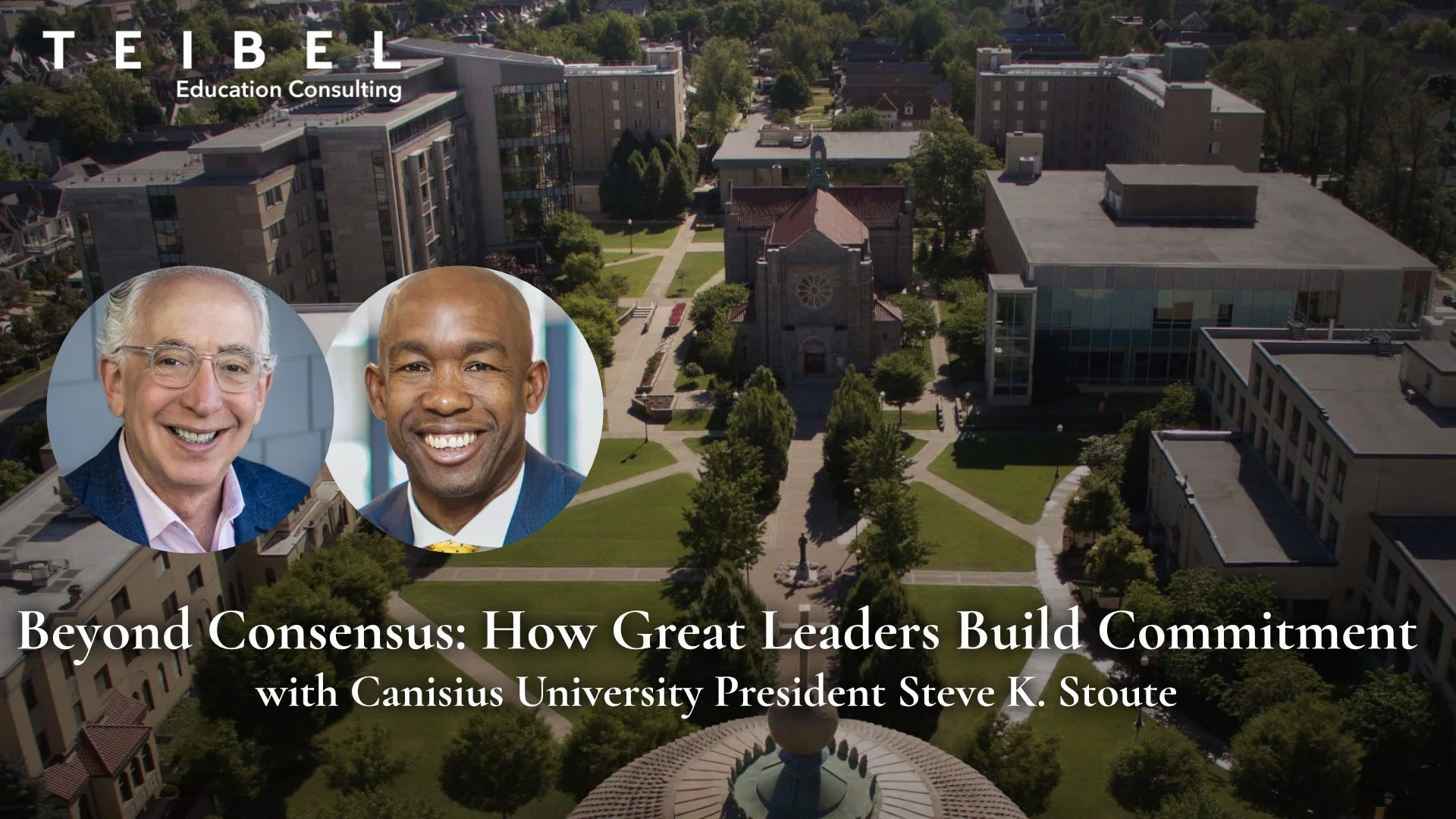
Canisius University President Steve Stoute moved his chief financial officer’s office across the hall from his own. He wanted to be able to stand up, walk over, and say, here’s what I’m thinking, let’s talk. It was the first of three things he did to get the CFO into the rooms where strategy gets made. The second was trust, said out loud and often. The third was a standing meeting invitation that his team has learned to treat as a requirement.
Steve is the twenty-fifth president of Canisius University in Buffalo, a Jesuit institution facing the same enrollment, financial, and public-confidence pressures he described in a recent keynote. In this conversation with Howard Teibel, he talks about how he leads inside those pressures. He separates consensus, which belongs to the process, from commitment, which belongs to the decision. He explains why he tells the student newspaper that he does not have an opinion as president. He describes what happens when a vice president gets out ahead of him, and why his first question is what he himself might have done differently. And he makes the case for “pilot” as the most important word in a university’s vocabulary, because an institution that can start, test, and stop is one that can protect the people willing to try something new.
Links & Notes
-
Steve Stoute:
Jobs change. We're seeing that now with the rapid pace of technology and the development of AI. Jobs change. And what we do in education is empower people to live lives of meaning, purpose, and impact. That is hard to quantify.My mom in particular is boundlessly hopeful. And I'm grateful that that's a gift she's given to me. And so I joke around my leadership table, I see no problems, I see only opportunities.
Pete Wright:
Steve Stoute, the president of Canisius University in Buffalo, gave a keynote recently about where higher education stands right now, and he didn't soften it. Enrollment, money, a public that isn't sure anymore what college is for. He knows the numbers cold. That's one side of him. There is another. Here, Steve sits down across the table from Howard Teibel and talks about how he leads, about trust, about the difference between consensus and commitment, and about where he finds a hope that is anything but naive. And now, Howard Teibel with Canisius University President Steve Stoute.Howard Teibel:
Thank you, Pete. President Stoute, it's a pleasure to have you and a privilege to be in this conversation with you. Thank you for being on the podcast.Steve Stoute:
Thank you so much for having me. I'm really looking forward to our conversation. I think it will be fun.Howard Teibel:
Before we get into the big challenges facing higher education, what's something about being a college president that you never expected and still makes you smile?Steve Stoute:
Never expected? I would say how easy it is to engage with our students. I remember myself as a student, and I don't think I would have had the confidence to approach our college president. I did get to know him, Monsignor Robert Sheeran. He approached me. And so I think that's the one thing, is how easy it is to engage with students. And it still, to this day, brings a huge smile to my face. It puts me at ease because they're incredible. Young people today, I know a lot is written about this generation and some of the challenges. They are truly amazing human beings.Howard Teibel:
I'm confident it's a function also of how you show up around them. But do you think there's a difference in their comfort level in approaching you as president? I have the same attitude. I never would have been comfortable, when I was an undergraduate, just walking up to my president and having a conversation.Steve Stoute:
Yeah. I do think there's something that's changed, in a good way, about how students view authority and the like. I hope some of it is how I present to them, because that's very intentional. I want to be approachable. I want them to know that I am part of the team that supports them and I'm here to help make their educational experience the best it can possibly be. And so I think college presidents shouldn't be set apart from the students, because hopefully we all get something meaningful out of engaging with our students.Howard Teibel:
Tell us about your journey, how you got to where you are today.Steve Stoute:
Yeah, it is, I think in many ways, quite fortuitous. I have been blessed to have the opportunity to lead Canisius University. And I did not at all set out thinking this is where I'd be and what I would be doing. And so I'm first of four kids. My parents didn't go to college.Howard Teibel:
Questions. Where did you grow up?Steve Stoute:
Trinidad and Tobago. Born and raised in Trinidad and Tobago. And so my parents didn't go to college, but they believed in the power of education to transform lives, and so sacrificed so much to give me the opportunity to immigrate.Four great years at Seton Hall University. I played soccer at Seton Hall, but even at Seton Hall, the instructions were simple from my parents. You're going to study business. You're going to get a degree and you're going to go to work and make a meaningful life for yourself and your family. And I had an opportunity at Seton Hall to serve on the board.
Howard Teibel:
At what point were you at Seton?Steve Stoute:
I graduated in 2004, and so this was as a young alum. There was a spot on the board. I don't think they do it any longer, unfortunately. But there was a spot on the board reserved for an alum who'd graduated less than five years prior.Howard Teibel:
Great model.Steve Stoute:
It is, and we actually started it at Canisius for that reason. It connects the trustees to the current student experience. And so I did that from 2005 to 2008. It's a non-renewable three-year term, but I learned so much about the people and the processes and the initiatives that it took to create this experience that I thought changed my life. And so I was in graduate school at the time at North Carolina, where I graduated in 2007. But when I finished my board term in 2008, I thought, I'm interested in pursuing higher education as a career.Howard Teibel:
What was your degree?Steve Stoute:
My degree from Seton Hall was in business. My degree from North Carolina is exercise sports science with a concentration in sport administration.So college sports administration. I thought I'd be an athletic director. I wanted to be on a college campus. My time at Seton Hall helped me understand that athletics, as much as I was passionate about it because it shaped my life, was a small part of the bigger institutional picture. And so 2008 was probably when I committed to doing the things I needed to build toward a college presidency, including law school at the University of Pennsylvania.
Howard Teibel:
Well, that's a perfect pivot to this next thing, and I'm going to see if I have this right. I've seen or have read somewhere that you shared that you attended law school not primarily to become a practicing attorney, but to strengthen your analytical skills and ability to make evidence-based decisions as a future university leader.Steve Stoute:
That's right.Howard Teibel:
I love this idea. Say more about that, because when we work with university leaders and I'm in the presence of someone with a law degree, or a law way of thinking, they bring us a different kind of listening, a different kind of capacity to use language to be able to move things forward. So say more about this, because I think this is a really important distinction between being a lawyer and having those skills.Steve Stoute:
Yeah, and I think what you said is exactly why I went to law school. A law way of thinking. I think that is what I bring every day, and I hope my colleagues would say that. And sometimes I hope they would say that's not always easy for them. It was said frequently at Penn, we will teach you to think like a lawyer. And in your first year of law school you don't understand what that means, but by the time you graduate, you understand what it means to think like a lawyer. And for me as a university president, that means processing vast quantities of information and understanding how to arrive at reasoned, sound conclusions and judgments from that information.Which today, I hope at Canisius we can infuse some of those tools and techniques into pedagogy, teaching students to think like that in our undergraduate curriculum. Because as AI advances, that is what will distinguish our institutions from others. That is what will make the case for why college is still valuable. Because you cannot learn to think anywhere else in the way students will need to think to work with AI in the future.
Howard Teibel:
No question. In the keynote, you talked about CFOs being at the table, not down the hall. How do you inspire, slash demand, this shift in thinking? And I say demand, but I'm going to use your language, rise. Because I can tell you at every level with the folks we work with, there is an understandable feeling of being intimidated, overwhelmed, and fearful of stepping ahead of your president, stepping ahead of your boss. So how do you get them? How do you inspire or demand that way of stepping up?Steve Stoute:
Having been not a CFO, but vice president for strategy and chief of staff at DePaul University in Chicago, I understand the need to be thoughtful and intentional about where the president stands on whatever the issue is, and not getting out ahead of it. With my CFO, Bob Beaumont, at Canisius, one, it was physical presence. Bob didn't have much to do with this, because we did it before he joined us, but the CFO's office is now across the hall from mine. And so I can physically just get up from my office, I can walk into his, and I can say, here's what I'm thinking, let's talk about this.Howard Teibel:
The whole body experience, just being in the room together. It changes everything. Versus seeing everything from the neck up.Steve Stoute:
Exactly. So that's one. And the second is, I do this with my CFO, but also with my team and the other vice presidents. I reinforce that I trust them. I believe in hiring good people, empowering them to do their work, and then trusting them to execute on our shared vision. Holding them accountable, yes, but there is a significant level of trust I have in the CFO that he will not go out there and say something that is so far afield that I will have to walk it back or pivot in some way. But I think one, it really is the physical presence. Two, it's this reinforced knowledge, not belief, knowledge, that I trust. I trust that we are aligned. I trust that you will bring your best self to this work.And the third piece is not necessarily demanding it, but forcing him into the rooms. And so I talked about our enrollment strategy leadership meeting. I think my team understands when you get a meeting invitation from me, it is not actually an invitation. You are required to be there. Yes, there may be topics when we're in that room that may not resonate with him, they may not be pertinent to him. But he knows he has to be in that room for that one moment, that one conversation, that one nugget, where he is the only person that can bring the insight we need to drive a good outcome for the institution.
Howard Teibel:
And that's also an opportunity for your vice presidents to prepare for a certain kind of thinking, because your rise to the presidency came from being in the room and learning what it looked like to be the one that people turned to. What happens when someone doesn't represent something and you question the trust in that moment? Because it happens everywhere. In our work, we talk about four dimensions of trust. Trusting your competency, trusting your reliability, trusting your sincerity, and trusting how you bring your care. You can assess trust through those dimensions, but when someone doesn't demonstrate something, how do you go about engaging them so they don't feel admonished, so that it's a learning moment?Steve Stoute:
Yeah, I love the four dimensions of trust as the way you and your colleagues do the work. And for me, much like I said on stage about how we view students and their success or lack of it as kind of institutional, I try to take responsibility first and foremost. If one of the vice presidents goes out and we're not aligned because they said something, I try to own it. What could I have done? What could I have done differently to avoid this moment? And then it's always a conversation. Help me understand what you're thinking, how you got there. And I'll ask questions, because it may ultimately be a shift that will best serve the institution.And so I don't outright say, well, this is not what we agreed on, so you have to walk it back. It's, help me understand what your thinking was, because maybe you encountered some data or you had a conversation that sparked something different in you based on that experience. We should all be the beneficiaries of that. So help me, teach me, help me learn.
Howard Teibel:
What that is for me, just you saying that and how you said it, it's a certain kind of humility. Edgar Schein, and this is my favorite thing from the book Humble Inquiry, talks about accessing your ignorance. You bring that, because you said, I look first at what it is that I might not have done. But the other thing that you said that was so remarkable and so important is that when you investigate why they made that different choice, you might actually go, you know what? That was a better choice.Steve Stoute:
Absolutely. Right outcome for the institution, for our students. I'm on board.Howard Teibel:
Yeah, it's beautiful. So an aspect that I'm really curious about, having done so much partnering with higher education institutions over the years, is that I say often there's a difference between consensus building and commitment building. Higher ed, in my opinion, is dominated by having to get to consensus. But consensus is very different than commitment. Consensus doesn't lead to action. How do you navigate this tension between the need to be inclusive of all the voices, but still make tough decisions?Steve Stoute:
I think that's probably the thing I had to learn the most in coming to the presidency. Because that is, to your point, part of our tradition in higher education. Building consensus. But we must, and this is one of the things I love about our Jesuit tradition, be people of action. And so building consensus does not, to your point, necessarily mean commitment. The way I approach it with my team and with our trustees is we will build an inclusive process. So consensus is about the process. We will bring as many voices as possible into the dialogue early, but the action, the decision, still rests with the leadership. The action still rests with my team and with me. And so we will move forward.We will act with commitment and with urgency, understanding that we may not bring everyone on board. I say this to our students. I had lunch with the editorial board of our student newspaper. I do this every year. And I said to them, one of the things they have to remember is I do not have an opinion as president.
Howard Teibel:
What does that mean?Steve Stoute:
It means when I speak as president of the university, I speak for all of our students, all of our faculty.Howard Teibel:
It's not an opinion of you as an individual.Steve Stoute:
Yeah. There is an institutional position. And when I do that, I have to be thoughtful of all of the diverse voices. I think in the same way about consensus and commitment, which is, I hear you. We've built this process where you've had input. We've considered that input. And here's the decision. And we are going to move forward with urgency and with commitment. And we expect that because you've participated in the process, you will not actively resist. I won't say you will come along, but you will not actively resist. If it's an outcome that you disagree with, or it wasn't the one that you advocated, you won't be an obstruction. Allow us to proceed, and continue to ask questions.Because if it doesn't work, the culture we try to build on our campus is not "I told you so." It's, okay, now can we revisit my idea, or can we revisit another way of doing things? And so I say to my team on our campus all the time, pilot is my favorite word in the dictionary. We do not have to start doing something and ingrain it in our institutional fabric forever. We can start, we can test, we can learn, and in two, three years we can come back to the table and say, it didn't work. And that's okay. It's a very different way of thinking, I believe, than what we've seen in higher education before, which is everything we've done doesn't need to be everything we will do for all time.
Howard Teibel:
Where this leads me is, I remember partnering with Canisius years ago and being in the room with the faculty senate and the president, and doing events where I was helping facilitate a gathering and building trust with the faculty. And I think this is relevant for CFOs too. I mean even more, because the CFO steps in the room and if they say anything, the faculty are going to go, they know that everything is through the lens of money. How did you, or how do you, go about building trust with the academic side of the house, which I think is also important for the audience listening to this?Steve Stoute:
Yeah, it's mission critical. And so what I often say is, first and foremost, we have to eviscerate the silos. This idea that there is academic and administrative. One Canisius is what we talk about. And so when we talk about the future of the institution, when we talk about the challenges and the opportunities, we have to do it from an institutional perspective.Howard Teibel:
Speak about the we, not the I.Steve Stoute:
Yes, absolutely. I think that's an inversion to the norm. If we think about, as we talked about earlier, structures, how our institutions are structured, and it's not specific to Canisius, I think this is the way our institutions have been structured. Faculty have a departmental home. That is their discipline. And they get tenure. And when we think about the tenure process, it starts in the department. And so they think department, then school or college, academic unit, then institution. And what we are asking, and what we need to do in this moment, is to flip that model and think institution first, then your broader academic unit, and then your disciplinary unit. It is not eliminating your discipline. It is not some great disrespect or disregard for the academic enterprise. It's simply a change in perspective.Howard Teibel:
To me, it's a critical shift in thinking, this idea of institution, school, department. But I'm confident that one of the dilemmas is people focus on what they're incentivized for. I need to grow my department. We shouldn't be demonizing silos, because we get work done in silos. But the problem is when you just focus on that, you're not taking care of the bigger concerns. So from my perspective, it needs to be both somehow. But I think the focus at this level is so much that they don't have the institutional, where are we going as a group? That takes time, to get people to focus on this. One of the things that I struggle with is how do you get people, what kind of commitment do you share with people? You've got your day job, but we're really talking about having to evolve the culture. That takes an almost completely different set of competencies and energy. How and in what way do you make time for that?Steve Stoute:
That is perhaps the thing I spend most of my time doing. At the State of the University address last week, I reminded our faculty and staff who were gathered about the saying, the quote that's attributed, rightly or wrongly, to Peter Drucker: culture eats strategy for breakfast. Because it is true. It doesn't matter who said it, it is absolutely true. We can be as strategic as we want. We can have the best, most thoughtful, intentional strategy for the future of the institution. If it lands in a culture that will cannibalize it, it doesn't matter how much we resource the strategy, it will fail.Culture takes time and we all have to be invested in it. And I think that is the conversation we need to continue to have at Canisius and on our campuses: what's the culture we want to build? Because the culture also sustains itself. One of my colleagues reminded me that in their building, our coaches say you get the culture you tolerate. And so if you want to build a culture where we experiment, to your point, then we have to incentivize innovation and experimentation, and not necessarily incentivize the status quo. Innovation is risky. And so if we want faculty to build new courses with different pedagogy, we have to incentivize that, but also protect against the fact that pilots don't always work.
And so the simple example I use with our academic leadership is, how do we carefully consider student evaluations in an experimental course? Because if the faculty member is going out on a limb to try something novel, they shouldn't be penalized if it doesn't work exactly the way they want it to, or students don't experience it in the way they expect to, because it's still an opportunity to learn, and we still want the faculty members to try. And so it is what we incentivize, but also how do we provide the protection around that innovation. Because innovation is risky. It is what we need. Like I said on stage, it is what we need at this moment. We have an opportunity to reinvent ourselves, but we will not be able to do that if we don't appropriately protect the dreamers and the doers.
Howard Teibel:
You know what I love about this? Mary and I were at the University of the Virgin Islands recently. We were at UVI supporting them in getting through some tough times. And one of the things we talked about is planting seeds. Because what's interesting about what you're talking about, as I listened to you tell the story, is that this is something that is never going away. The distinction I make, because you talk about navigation, is the difference between a problem and a dilemma. Problems can be solved. Dilemmas need to be managed. Everything you're describing is a dilemma that has to be continuously looked at. It takes energy, but it's never going to be solved.And I think one of the things that's important for our leaders, the people that report to you in your organizations, is to be able to distinguish, this is something we're going to be engaged in for your whole career, and how do you grow that? Getting people who are tangible, who are problem solvers, to be able to step back like that. This is something I fundamentally believe is a core competency to develop, not just at the most senior leaders, but at the level that you're trying to inspire. How do you get people to think more in this navigation mindset?
Steve Stoute:
For us, I think it's an unfair advantage. We lean into our Jesuit way of proceeding. Ignatius talked about holding things in tension, in conflict. And so, you're absolutely right. There is no solution. We don't have to solve this problem. We have to discuss it, we have to debate it, we have to view it from all sides. We have to make progress. We ultimately have to move the institution forward. But this isn't something we will solve. In this moment, in this time, we've arrived at a reasonable conclusion that will help us move forward. And then again, like I said on stage, we are stewards. We're here for a moment in time. Someone else will come along and wrestle with the same, perhaps slightly different, dilemma in the future.And their outcome may be different. Their way forward may be different than the one we would have chosen, but we did the best we could under the circumstances with the information we have. And so, slightly unfair, but we are able to lean into an almost 500-year-old tradition that says we must be able to hold these seemingly competing ideas in conflict, live in that tension, because it makes us better.
Howard Teibel:
Jesuit universities and colleges happen to be my favorite. And that's because I would go into these meetings and they would start with a prayer. You can't do that in a public institution. The prayer was really intended to call us to a higher purpose, and remind us of that. And that often gets lost. All right, so I'm going to give you a dilemma here. You talked a lot at the keynote address about the financial challenges, some of the statistics, the enrollment cliff.What has happened to learning for learning's sake, and is it gone? Is that really in our past, to be able to get an education for that purpose? Because the dominant conversation today, as you raised, and you hear it everywhere, and you read in the Chronicle, is lifetime earnings. How do we make this viable? How do we reduce cost? But it feels to me that that conversation about learning for learning's sake is disappearing. And that worries me.
Steve Stoute:
I would absolutely agree. I do not think it is lost. I don't think it's in the past permanently. This is the societal case. Like I said earlier, what we do is about the future of this country and of this society. And yes, in higher education, we are losing the battle. In this moment, we are losing the battle, because the public discourse around what we do is career earnings and jobs.Jobs change. We're seeing that now with the rapid pace of technology and the development of AI. Jobs change. And what we do in education is empower people to live lives of meaning, purpose, and impact. That is hard to quantify. So I would say no, it's not lost. We have departed from that. And not we in the sector. We still know that. We still talk about learning for learning's sake and the value of a liberal arts education. We still discuss those, but we've lost the public battle.
And to be honest, I think that is a fair criticism of presidents, of me and my colleagues. Because what we say, and what we reinforce by saying it constantly, will ultimately permeate the public consciousness. And I understand it, because I take this perspective, and I said earlier, I don't have an opinion, so I don't speak for myself. And there are too few of us who are using the op-ed pages and using our platforms to continue to articulate the true value, the societal case for higher education.
I think we've given in to, we have to generate revenue and we've got to balance the budget. And so we have to speak in the way students and parents want to hear, which is return on investment. And that's a delicate balancing act. But again, those are the things we have to hold in conflict, us college presidents, today, and find a way to do both. Find a way to articulate, here is the economic case for a college education. Both/and. Here is the societal case. It is, yes, about your career, yes, about economic prosperity for you and your family. It is also about being a good citizen, the future of our democracy, the future of our world. That to me is the job, and that's really exciting.
Howard Teibel:
So if it's just you and me in conversation, and nobody's listening, what I am curious about is, where does your positivity come from?Steve Stoute:
I think from my parents. I think from my parents, and growing up in Trinidad, in our little village, and their belief, their sheer belief that no matter how hard things got at any point in time, we would be okay. Our faith, our family. And so my mom in particular is boundlessly hopeful. And I'm grateful that that's a gift she's given to me. And so I joke around my leadership table, I see no problems. I see only opportunities.Howard Teibel:
Yeah, that reminds me of a book I'm reading called Radical Hope. And what you just said here is beautiful. That's what we have to remember, to not get sucked into what's happening around us, but still bring that hope. So I want to say thank you for inspiring me, for bringing this energy and positivity to this community of leaders here, but also to Buffalo, New York, which is my hometown. So thank you so much. You are truly an inspiration, and I appreciate you being in the conversation.Steve Stoute:
Thank you for the invitation to participate in the conversation. Thank you for the chance to be with you and just share a little bit about our shared mission. I think that's the thing you and I have been talking about and have in common, as will all of our listeners. We're invested in this work together. We're partners in this work together. And together we can accomplish great things, bearing in mind that we are stewards of that mission for a short time. And then we will pass it on to the next generation, and we can kick up our feet and relax.Howard Teibel:
Beautiful. Peace be with you.Steve Stoute:
And with you. Thank you.Howard Teibel:
You're welcome.